Color Night Vision vs Infrared Night Vision CCTV Cameras
Choosing the right CCTV camera isn't just about resolution or price. One of the most important features to consider is how well the camera performs after dark. Most security incidents, including theft, trespassing, and vandalism, happen during the evening or at night, making night vision one of the key factors when selecting a CCTV system.
If you've started comparing CCTV cameras, you've probably come across terms like Infrared (IR) Night Vision, Color Night Vision, Full-Color Cameras, and Smart Dual Light. While these features may sound similar, they work differently and are designed for different situations.
Some homeowners assume every CCTV camera records in full colour at night, while others believe infrared cameras provide the clearest images in complete darkness. The truth lies somewhere in between. Each technology has its own advantages, limitations, and ideal use cases.
In this guide, we'll explain the differences between color night vision and infrared night vision in simple language. By the end, you'll know which option is best for your home, apartment, shop, office, warehouse, or commercial property.
Why Night Vision Is One of the Most Important CCTV Features
Most people think about CCTV cameras during the day because that's when they install them and test the live view. However, a good security camera should perform just as well at midnight as it does at noon.
Imagine someone approaching your gate late at night. If your camera only records a dark silhouette, it may be difficult to identify the person's face, clothing, or vehicle. A camera with good night vision can provide much clearer evidence if an incident occurs.
Night vision becomes especially important for monitoring:
- Main entrances
- Back doors
- Parking areas
- Driveways
- Compound walls
- Shops after business hours
- Warehouses
- Offices
- Outdoor storage areas
No matter how advanced a CCTV system is, poor visibility at night can reduce its effectiveness.
If you're still deciding where cameras should be installed around your property, read our CCTV Camera Placement Guide. It explains the best locations for homes, apartments, shops, and offices to improve security and reduce blind spots.
https://cctvsurveillancecameras.in/blog/cctv-camera-placement-guide
How CCTV Cameras Capture Images at Night
To understand the difference between infrared and color night vision, it helps to know how CCTV cameras see in low-light conditions.
During the day, cameras rely on natural sunlight or artificial lighting to capture colour images. As daylight fades, less light reaches the camera's image sensor. If there isn't enough light, a standard camera struggles to produce a clear picture.
To solve this problem, CCTV manufacturers use different technologies.
The two most common are:
- Infrared (IR) Night Vision
- Color Night Vision
Although both are designed for low-light environments, they produce very different results.
What Is Infrared (IR) Night Vision?
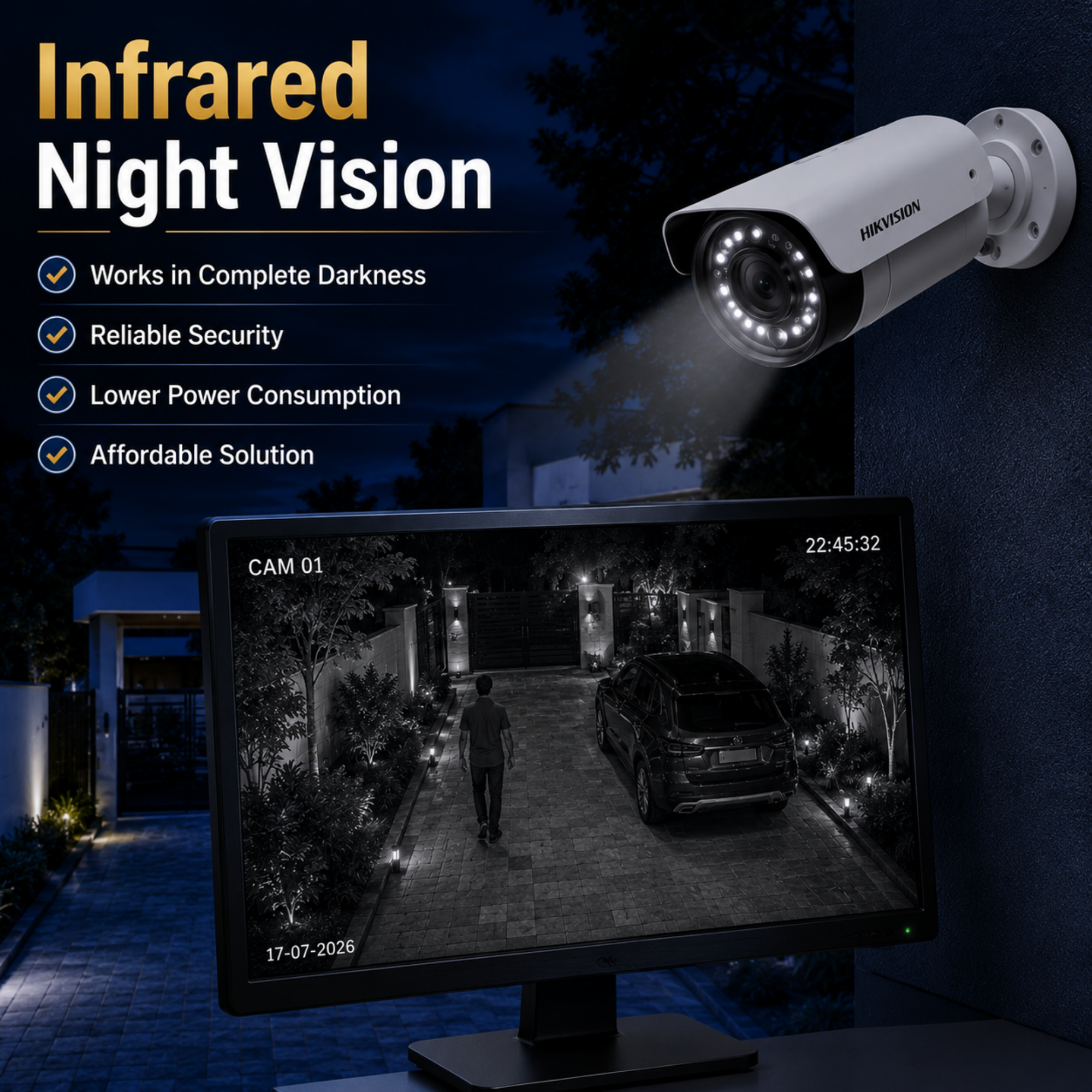
Infrared night vision is the most common night vision technology found in CCTV cameras. These cameras use small infrared LEDs positioned around the lens. The LEDs emit infrared light, which is invisible to the human eye but can be detected by the camera's sensor.
When the surrounding area becomes dark, the camera automatically switches from colour mode to black-and-white mode. The infrared LEDs illuminate the scene, allowing the camera to continue recording even in complete darkness.
This is why most traditional CCTV footage captured at night appears in black and white.
Infrared cameras are popular because they provide reliable performance without requiring additional lighting.
Advantages of Infrared Night Vision
Infrared CCTV cameras remain one of the most widely used options for residential and commercial security.
Some of their key advantages include:
Works in Complete Darkness
Infrared cameras can record even when there is no visible light. This makes them suitable for locations where outdoor lighting is limited or unavailable.
Affordable
Compared to full-color night vision cameras, infrared models are generally more affordable while still providing dependable night-time surveillance.
Lower Power Consumption
Since infrared LEDs only activate when lighting conditions become poor, these cameras often consume less power than cameras using bright white LEDs for colour recording.
Proven Technology
Infrared night vision has been used for many years and continues to be a reliable choice for homes, shops, offices, warehouses, and factories.
Limitations of Infrared Night Vision
Although infrared cameras perform well in darkness, they also have some limitations.
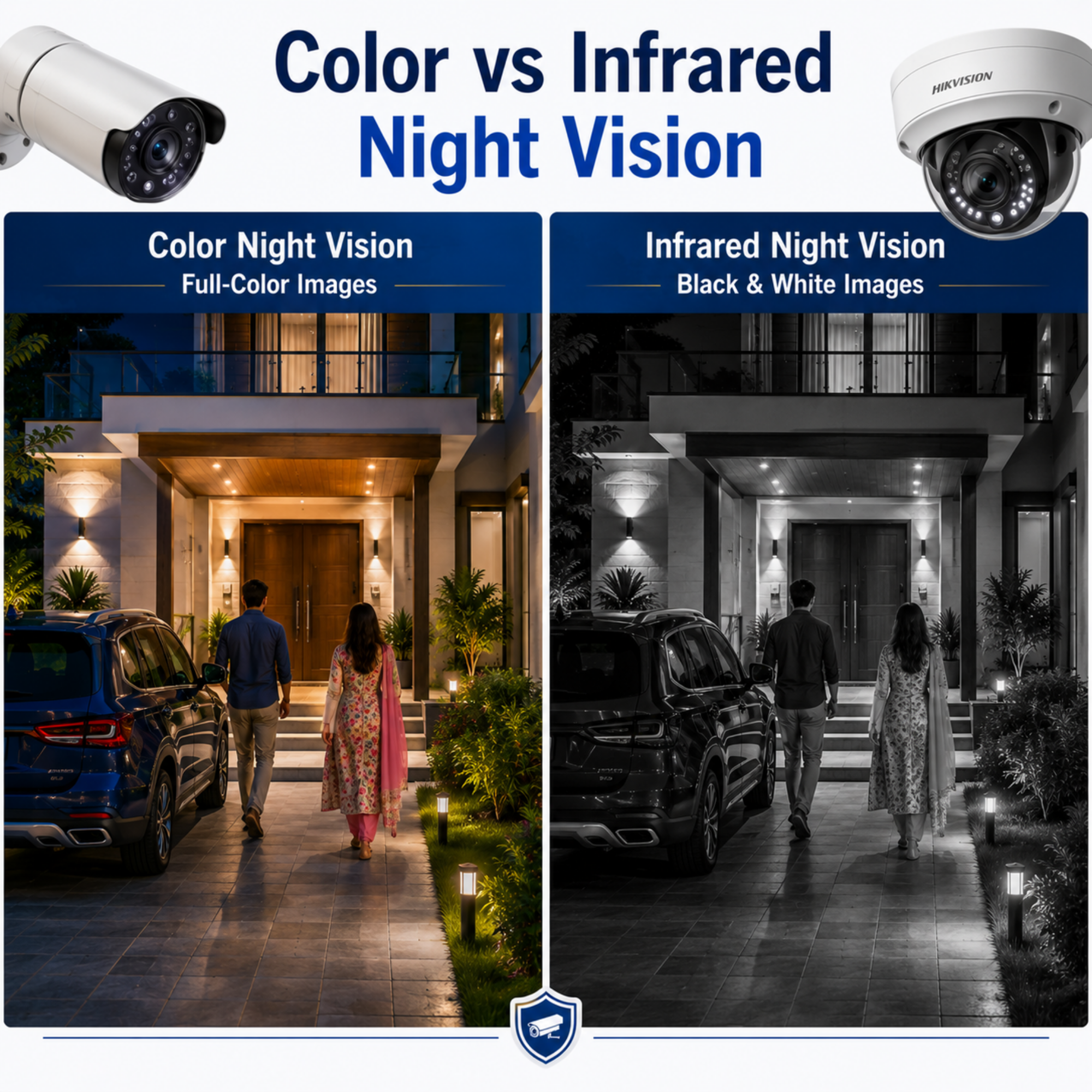
Black and White Images
The biggest limitation is that recordings are usually in black and white.
While facial features are often visible, it may be difficult to identify:
- Clothing colour
- Vehicle colour
- Bag colour
- Object colour
These details can sometimes be useful when identifying a person or vehicle.
Reflection Problems
Infrared light can reflect from shiny surfaces such as:
- Glass doors
- Metal gates
- Number plates
- White walls
These reflections may reduce image quality if the camera is not installed correctly.
Proper camera positioning plays an important role in reducing glare and improving night-time performance.
What Is Color Night Vision?
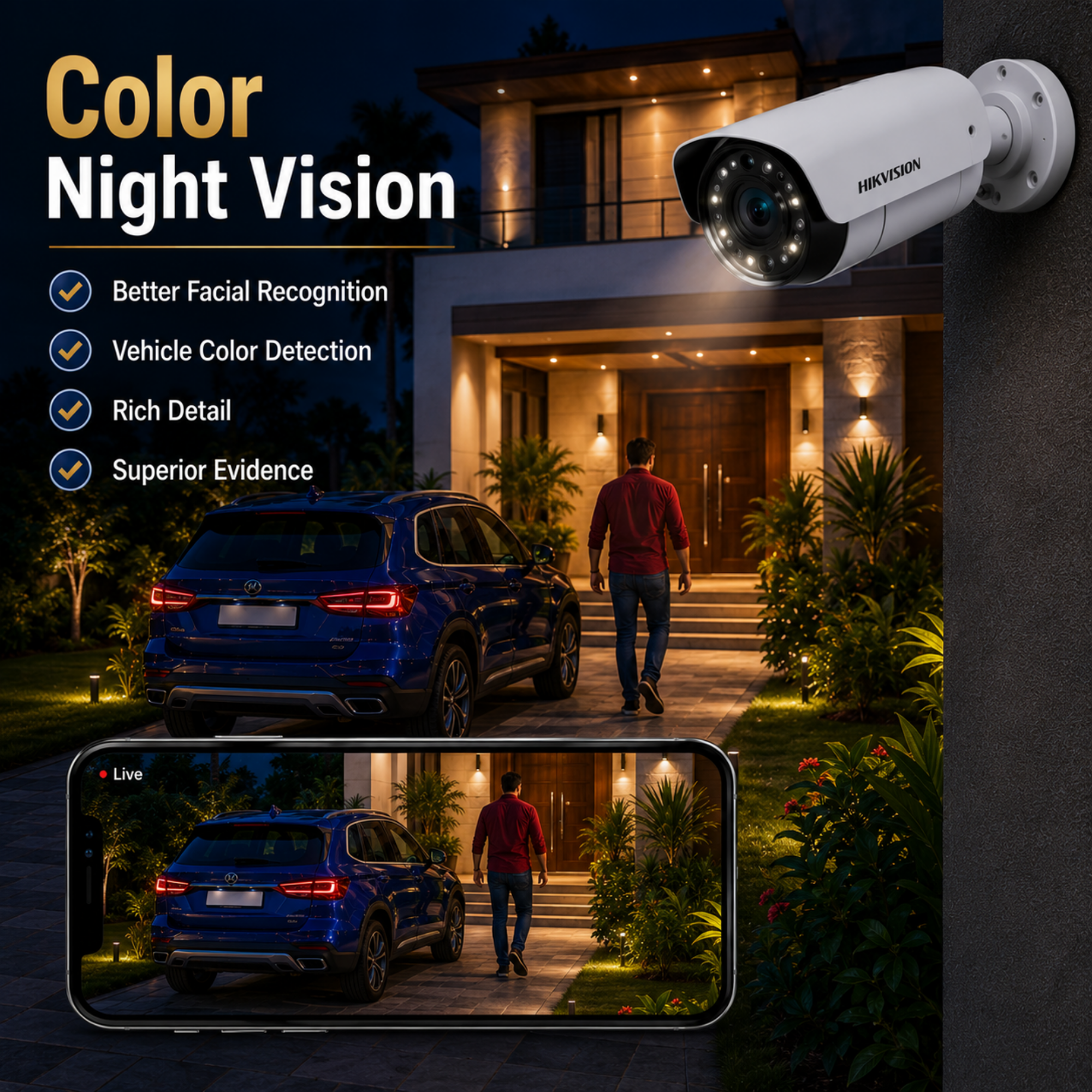
Color Night Vision is a newer CCTV technology that allows cameras to continue recording in full colour even after sunset.
Instead of relying only on infrared light, these cameras use advanced image sensors, larger camera apertures, and sometimes built-in white LEDs to capture brighter images in low-light conditions.
As long as there is some ambient light—such as street lights, porch lights, garden lights, or nearby building lights—the camera can usually continue recording in colour.
Some premium models can even switch intelligently between colour mode and infrared mode depending on lighting conditions.
Advantages of Color Night Vision
Better Facial Recognition
Colour footage often provides more detail than black-and-white recordings, making it easier to identify people.
Facial features, skin tones, and clothing become much clearer.
Easier Vehicle Identification
A colour recording allows you to identify:
- Vehicle colour
- Vehicle model
- Company branding
- Delivery vehicles
These details can be extremely useful during investigations.
Improved Evidence
If an incident occurs, colour footage generally provides more useful information than monochrome footage because investigators can distinguish colours of clothing, bags, helmets, and vehicles.
Better Overall Image Quality
Modern colour night vision cameras usually include improved sensors that also provide excellent daytime image quality.
Infrared vs Color Night Vision: Which One Is Better?
The answer depends on where the camera will be installed.
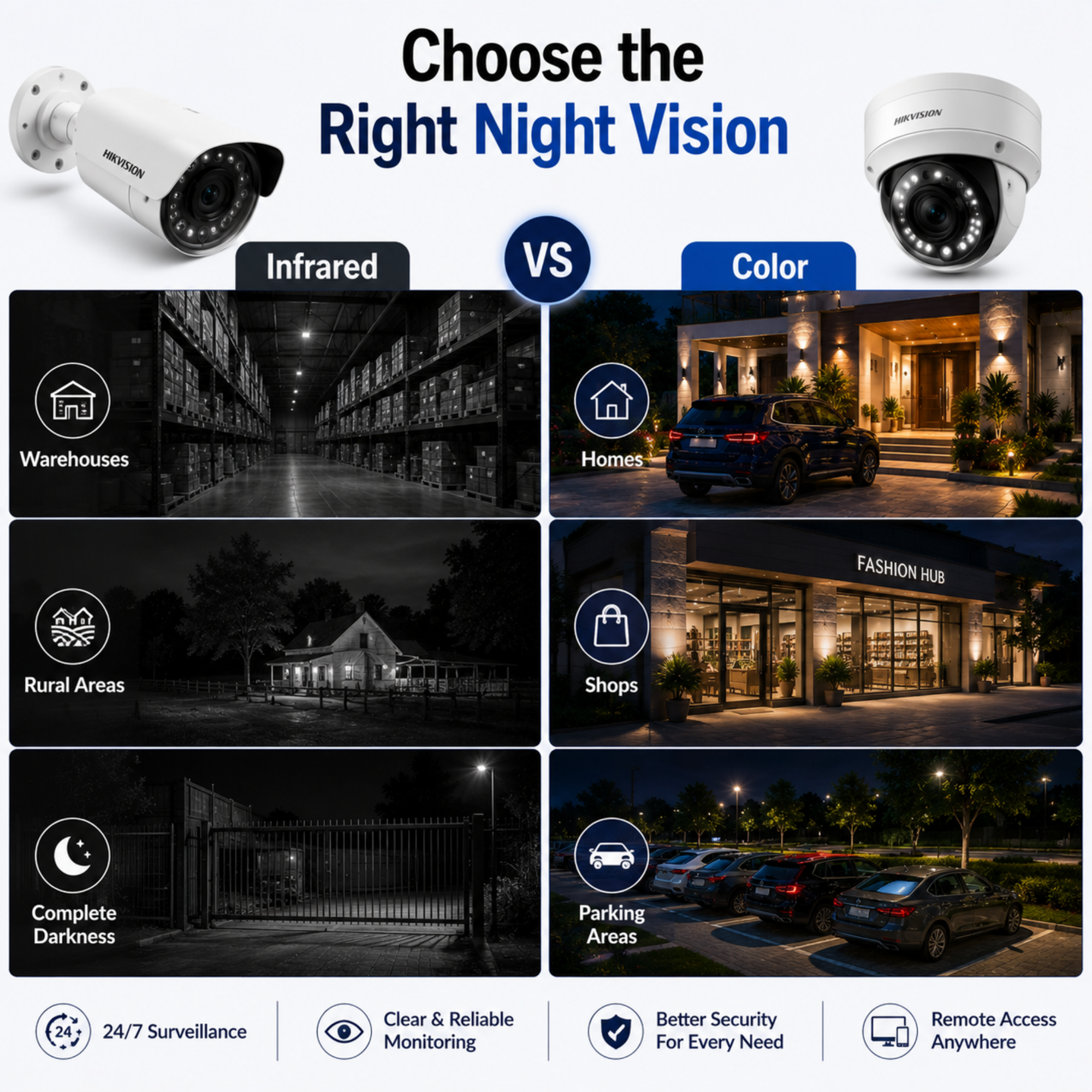
If the area has very little or no lighting, an infrared camera remains an excellent choice because it can continue recording in complete darkness.
If the area has some lighting—such as a front gate, parking area, driveway, or shop entrance—a colour night vision camera can capture more useful details.
Rather than asking which technology is universally better, it's more helpful to ask which technology suits your property.
If you're also deciding between wired and wireless CCTV systems, it's worth reading our detailed comparison before making your purchase.
https://cctvsurveillancecameras.in/blog/wired-vs-wireless-cctv
A wired system often provides more stable performance for larger properties, while wireless systems may be suitable for smaller homes and apartments.